July 9, 2013

For virtue, grace and manners make the man


It's Tuesday and that seems like a fine day to rub shoulders with some royalty.  Want to come along?  Having left Great Hopes Plantation, why don't we stroll down the lane to the Governor's Palace?  Completed in 1722 after sixteen years of construction, it served as home to seven royal governors as well as Virginia governors Patrick Henry and Thomas Jefferson.  A professor from the College of William and Mary described the Palace in a book published in 1724, when the city was just 25 years old.

"From the Church," he wrote, "runs a Street northward called Palace Street; at the other end of which stands the Palace or Governor's House, a magnificent Structure built at the publick Expense, finished and beautified with Gates, Fine Gardens, Offices, Walks, a fine Canal, Orchards, &c. . . . This likewise has the ornamental Addition of a good Cupola or Lanthorn, illuminated with most of the Town, upon Birth-Nights, and other Nights of occasional Rejoicings."

The word "Palace" was first used for the governor's house about 1714. Whether the term was used as irony in reference to its expense, or simply to designate an official residence is debatable.  When all was at last done, however, the building measured up to the name compared to other colonial structures, but not to European palaces. There stood a five-bay Georgian home laid up in Flemish bond with glazed headers and rubbed brick window jambs and lintels. It had three floors of about 3,380 square feet each, a cellar with 11 wine bins, a row of dormers in the roof, and an iron balcony at the central upper window. Just inside the gate – guarded by a stone unicorn on one side and a stone lion on the other – stood two one-and-one-half story brick advance buildings with gabled roofs.


Beyond the house was a formal garden in which guests could stand on the mound of earth that covered the ice-house to look into a large, naturalistic park that stretched away to the north.
 The stable, carriage house, kitchen, scullery, laundry, and an octagonal bathhouse were arranged in service yards beside the advance buildings.

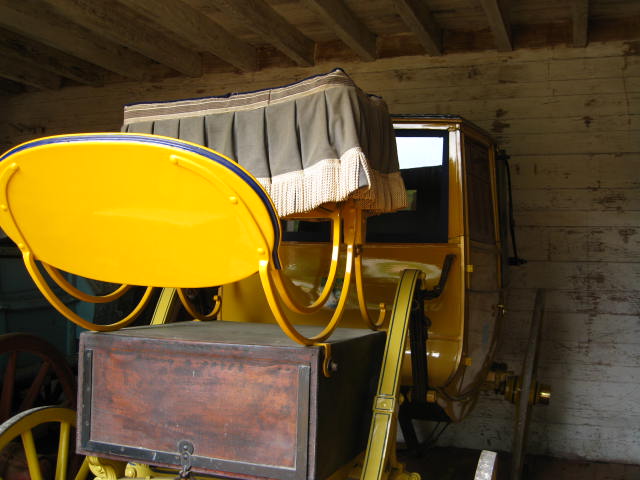
This carriage carried Queen Elizabeth II on her last trip to Williamsburg in 2007.  What do the British think when they visit Williamsburg, I wonder? 
Let's take a peek inside, shall we? The grand hallway was built to impress, and intimidate, the visitors to the Palace.  I was most suitably in awe.
The decorative weapons were put to use, however, when the city recoiled from the removal of gunpowder from the Magazine in 1775.  The final British Royal Governor, John Murray, the fourth Earl of Dunmore, summoned 40 sailors to the Palace to protect him from angry citizens. On May 15, 1775, he said he had turned it into a garrison. On June 8, Dunmore fled under cover of darkness, never to return. The Palace muskets and swords were pulled from the decorative displays by a delegation of local men and carried to the Powder Magazine for use in defending the colony.

Following the hasty royal retreat, General Charles Lee of the Continental army made the Palace his headquarters until it became a hospital. Then Virginia's government ordered the structure renovated for Governor Patrick Henry. Thomas Jefferson succeeded Henry in office and residence. In 1779 he drew a floor plan of the Palace, perhaps with a view to remodeling. The government, however, moved the next year to Richmond, and nothing came of the plans. The Palace served again as a hospital in the fall of 1781, this time for American soldiers wounded in the Battle of Yorktown. Some 156 of them, and two women, are buried in the garden.

But before the War, and the disrepair it finally fell into, the Palace was home...even if it was less impressive than many of the family homes British royal governors were accustomed to back in England.  Bedrooms had to accommodate both the children and their governesses.  I am sure you can figure out which bed belonged to each (don't let the doll fool you!)

The Palace hosted the colony’s fashionable society and finest entertainments. The October 31, 1771, Virginia Gazette reported:
"Last Friday night being the anniversary of our Most gracious Sovereign's Accession to the Throne, his Excellency the Governor gave a Ball and an elegant Entertainment at the Palace, to a numerous and splendid Company of Ladies and Gentlemen."
The magnificent ballroom is painted a dazzling blue called Palace Ballroom Wallpaper Prussian Blue.   Note the harpsichord and the carpet that was definitely meant to impress!
If you forgot for a moment that you were still a subject of the Royal Crown, the watchful eyes of King George III and Queen Charlotte quickly reminded you of where your loyalty ought to lie!
And if you grew weary of hours of dancing (with very few chairs available for resting tired feet) you could partake of light refreshments and punch in the adjoining supper room, with its vivid green walls and equally impressive carpeting!
Or, if the air grew stale and the talk turned to politics, you could always escape to the gardens for a quiet rendevous!
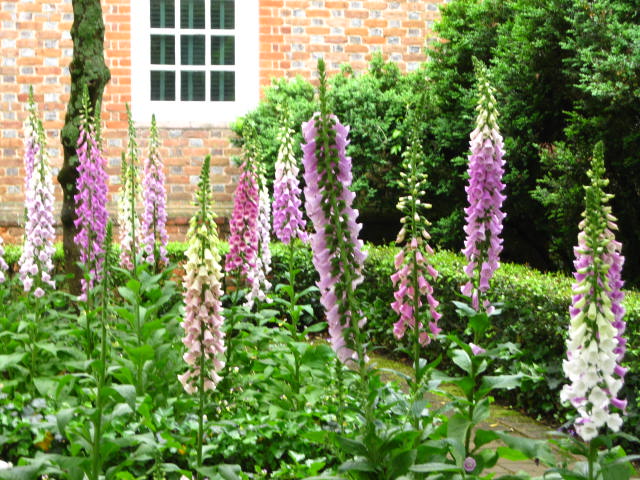
Let's finish with a stroll around the lovely gardens, my favorite part of the Palace tour.


And once again, here is a favorite poem of Thomas Jefferson's, an extract from the "Mirror for Magistrates"  (anonymous) that was copied in Jefferson's own hand into his scrapbook.  "Mirror for Magistrates" was a collection of English Renaissance poems that dates to 1560.  It seems most apropos after our tour of the Palace and its lovely gardens.

WHAT doth avail to have a princely place,
A name of honour, and a high degree;
to come by kindred of a noble race.
Except we princely, worthy, noble be!
The fruit declares the goodness of the tree
Do brag no more of birth, or lineage then;
For virtue, grace and manners make the man.


July 8, 2013

Work, work, and more work....

It's Monday morning and time to return to work after a perfect four-day weekend.  If only I could figure out how to work three days a week and have four days to enjoy, wouldn't that be lovely?!  But since that isn't going to happen anytime soon, I relished my "mini-staycation".  My workplace gave us both the 4th and the 5th of July off, and since my husband's employer did the same, we had four days in a row for all the fun we could rustle up!  And let me tell you, we are good rustlers.
We grilled out on the 4th, enjoying time with our sons and daughter and her fiance'.


We topped off the evening with a personal fireworks display in our backyard,
watched the Capitol 4th on PBS ( hate to say it, but did anyone else think Barry Manilow seemed...stiff?)
and enjoyed our special recipe for Good Times Pound Cake with ice cream and fruit compote. (  "[upon receiving a bundt cake from Mrs. Miller]  Maria Portokalos: It's a cake! I know! Thank you! Thank you very, very much.[whispering to Aunt Freida] Maria Portokalos: There's a hole in this cake!" (hopefully you've all seen My Big Fat Greek Wedding...!)
The rest of the time I worked on a special garden project (to be revealed here soon!), read a couple of books, worked on two cross stitch designs, saw several movies at home plus White House Down at the movie theater, enjoyed a date night with my husband, and spent marvelous hours sitting on my back deck just doing...nothing.  I very seldom get the chance to do nothing.  Wow, it feels wonderful!
 
Coming on the heels of Independence Day, it seems like the perfect week to visit Colonial Williamsburg, a living history museum as well as a private foundation representing the historic district of the city of Williamsburg. The 301-acre historic area includes buildings dating from 1699 to 1780.

Early in the 20th century, the restoration and re-creation of Colonial Williamsburg, one of the largest such projects in the nation, was championed by John D. Rockefeller, Jr., the patriarch of the Rockefeller family, along with his wife, to celebrate the patriots and the early history of the United States.  While initially the town was worried about how it would affect the community, it has grown into an amazing place to visit and learn more about our country's beginnings.  Let's start with a stroll through a typical early 18th century farm before we enter the city proper. Or even better, let's get in the spirit with more appropriate transportation...buggy ride, anyone?
Our first stop is at Great Hopes Plantation, which is a far cry from what you might expect a "plantation" to look like--it doesn't like a thing like Tara or Twelve Oaks!  According to Williamsburg agricultural specialist, Wayne Randolph:  "The chief quality of life on a Virginia farm in the 1700s was work, work, and more work." Work ebbed and flowed with the seasons, but it never stopped. From tending crops to butchering livestock to cooking, cleaning, or mending fences and tools, there always was something to be done.  Huge plantations, like Berkeley (which we will visit later) had armies of laborers, but small to middling plantations like Great Hopes covered about 200-800 acres and used a workforce of approximately ten adults.
Work, work and more work....
Thomas Jefferson admired these Virginia farmers for their skill, sobriety, industry, and contributions to their communities. He had them in mind when he wrote, "Those who labor in the earth are the chosen people of God."  Eighteenth-century farms had no machinery in the sense that we think of it. Laborers used simple hand tools. With them, eighteenth-century Virginians focused their greatest attention on three cash crops—tobacco, corn, and wheat.
Besides cultivating the cash crops, farmers grew peas, beans, oats, potatoes, turnips, pumpkins, cabbages, carrots, melons, and other fruits like apples and peaches. They also raised cattle, swine, sheep, and poultry. These foodstuffs were consumed on the farm, although some surplus might be sold locally or exported. 
Kitchen at Great Hopes
Slave quarters, exterior and interior

Tomorrow we will visit the Governor's Palace and meet some of the local citizens, who were quite miffed the day we were there about taxation without representation.  A local hothead, Patrick Henry, got the crowd pretty stirred up!  This week I am going to share a few of the poems that Thomas Jefferson chose for his own personal scrapbook.  As I mentioned earlier, he was an avid reader and book collector, and all his life he clipped out essays and poems he especially admired and pasted them into a scrapbook.  The scrapbook is now a book titled Thomas Jefferson's Scrapbooks, Poems of Nation, Family, and Romantic Love.  Here is one of the three poems he included that celebrate liberty.  The poet is unknown.

Hail Liberty

Hail Liberty! supreme delight
Thou idol of the mind;
Thro' every clime extend thy flight,
The word range unconfin'd.

Tho' all the Tyrants in the world,
Conspire to crush thy fame;
Yet shall thy banners be unfurl'd,
Eternal be thy name.

Then let mankind in one great band
Of glorius unity,
Drive Despotism from each land,
Or die for Liberty.

Columbia's sons! how blest are ye
Safe from tyrannic sway;
Maintain your rights, live ever free,
Drive discord far away.

July 2, 2013

The World Turned Upside Down

Let's leave the genteel cobblestone paths, the homes and taverns of Yorktown and walk to the edge of the town, where in October of 1781 a stunning reversal of fortune signaled the end of fighting in the American colonies, when Lord Cornwallis signed orders surrendering his British Army to a combined French and American force.
Cornwallis' second-in-command, Charles O'Hara, attempted to deliver Cornwallis's sword to French general, Comte de Rochambeau. But Rochambeau directed O'Hara to American General George Washington, who coolly steered the British officer to Washington's own second in command, Major General Benjamin Lincoln.
This ended a three-week old siege which had begun with the miraculous convergence of French and American forces on the Chesapeake Bay. With just a brief window of opportunity to pin Cornwallis in Virginia, Washington and Rochambeau raced southward from New York to link up with the French fleet under Admiral Comte de Grasse in Chesapeake Bay. They arrived just in time to corner the British, who were anticipating relief that never came from either General Henry Clinton or the British fleet.

Off shore, the French fleet effectively blocked aid from Cornwallis.

On shore, the incessant shelling of the French and American guns made life miserable for the British troops.

When a British officer finally appeared with a white flag on the parapet surrounding Yorktown, the French and American guns fell quiet.

The Continental forces let go a momentous cheer until Washington ordered it silenced. "Let history huzzah for you," he was heard to shout.

And as the defeated British troops marched out of Yorktown, their band played the English ballad "The World Turned Upside Down", which had originally been published in the middle of the 1640s as a protest against Parliament's policies outlawing traditional English Christmas celebrations.

Listen to me and you shall hear, news hath not been this thousand year:
Since Herod, Caesar, and many more, you never heard the like before.
Old Christmas is kicked out of Town
Yet let's be content, and the times lament, you see the world turn'd upside down.
The wise men did rejoyce to see our Savior Christs Nativity:
The Angels did good tidings bring, the Sheepheards did rejoyce and sing.
Let all honest men, take example by them.
Why should we from good Laws be bound?
Yet let's be content, and the times lament, you see the world turn'd upside down.
Command is given, we must obey, and quite forget old Christmas day:
Kill a thousand men, or a Town regain, we will give thanks and praise amain.
The wine pot shall clinke, we will feast and drinke.
And then strange motions will abound.
Yet let's be content, and the times lament, you see the world turn'd upside down.
Our Lords and Knights, and Gentry too, doe mean old fashions to forgoe:
They set a porter at the gate, that none must enter in thereat.
They count it a sin, when poor people come in.
Hospitality it selfe is drown'd.
Yet let's be content, and the times lament, you see the world turn'd upside down.
The serving men doe sit and whine, and thinke it long ere dinner time:
The Butler's still out of the way, or else my Lady keeps the key,
The poor old cook, in the larder doth look,
Where is no goodnesse to be found,
Yet let's be content, and the times lament, you see the world turn'd upside down.
To conclude, I'le tell you news that's right, Christmas was kil'd at Naseby fight:
Charity was slain at that same time, Jack Tell troth too, a friend of mine,
Likewise then did die, rost beef and shred pie,
Pig, Goose and Capon no quarter found.
Yet let's be content, and the times lament, you see the world turn'd upside down

July 1, 2013

A perfect day!


"Rest is not idleness, and to lie sometimes on the grass on a summer's day listening to the murmur of water, or watching the clouds float across the sky, is by no means a waste of time."   
--John Lubbock

This weekend I saw an awful television preview for an upcoming show featuring that little "Honey Boo Boo" and her family, and the advertisement was touting the experience as a "scratch and sniff" show--with scents involving sour milk, perspiration, diapers and worse.  Really??  I am hard pressed to think of anything less appealing, but it did start me thinking about how much I wish I could share my perfect Sunday with you, complete with a scratch and sniff feature so you could experience my garden with me!

Martha's "scratch and sniff" Sunday garden: 
My birdbath and little fairy are almost lost among the coneflowers!
Stella d'Oros daylilies, nestled in among the purple salvia, are finally blooming!

Oh my goodness...nothing smells as sweet as honeysuckle (well, except for maybe peonies and lilacs!)

After four years, my clematis has finally bloomed!

"My love is like a pink, pink rose" (sorry Robert Burns, no red roses in my garden!)
My definition of a practically perfect Sunday:

It starts with a great cup of coffee in a favorite mug (my husband and I used to collect coffee mugs when we traveled, so my cups all bring back wonderful memories) sitting on my back deck while the sun comes up and birdsongs fill the air,
 followed by a trip to Home Depot to fill my remaining pots

And finally cleaning up the side porch and creating a bit of Mediterranean loveliness.  I love the cobalt blue with a pop of orange and red!  I'm trying to stretch my garden color palette beyond pastels!
 A quick shower and an early matinee at the "cheap" theater, and the opportunity for my husband and I to enjoy (and, I'll admit it, cry a little) over a beautiful movie, The Quartet.  If you haven't seen it yet, I highly recommend it.  I think it may be out on DVD now, but I'm glad I got to see it on the big screen. 

The perfect day continues by relaxing on my deck mid-afternoon with my favorite magazine:

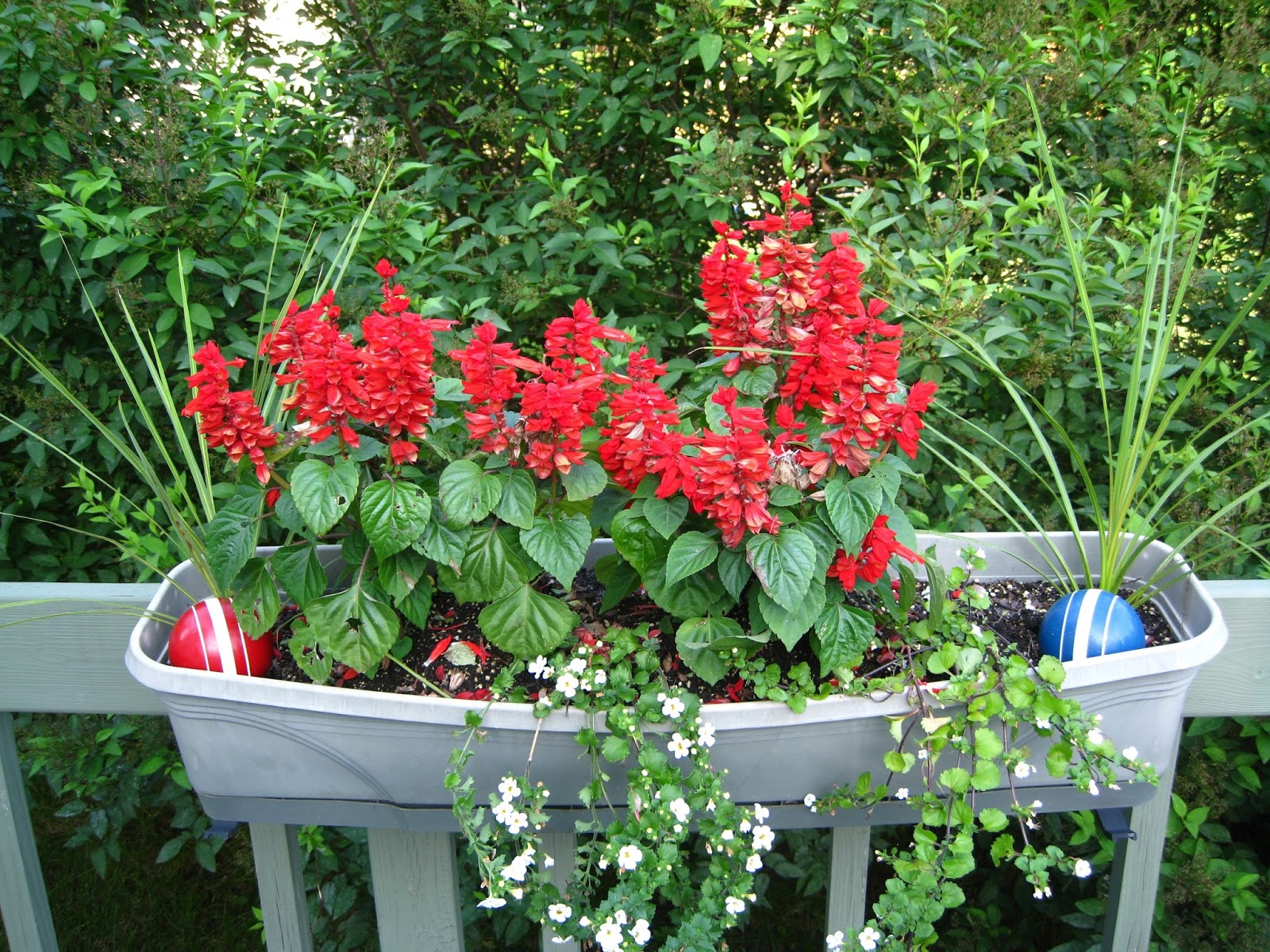
and discovering a perfect place for antique croquet balls!
It wraps up with cooking a Sunday dinner for my family--citrus marinated pork chops with fresh mango salsa, a fresh corn and cherry tomato salad, and pineapple balsamic rice.  I was obviously on a citrus kick, but oh my, everything was so fresh and delicious!  My favorite apron on, Carly Simon singing in the background, and the opportunity to adorn my table with blue delphiniums and coneflowers from my garden---perfect!
and enjoying a glass of wine while my husband grilled the pork chops, my daughter chatted and an inquisitive bird dropped by to say hello!

And my perfect day ended up with pound cake and cherry ice cream, followed by watching the stars come out and the lightning bugs light up the backyard while I huddled under a wrap on my glider.  A day like yesterday is such a gift, and for that, I am very, very thankful.

June midnight
with a pale moon.
The pink oleanders
tap outside my window,
cast shadows in the room.
I lie in bed,
wonder if my eyes will ever close
when suddenly,
a flash of light darts across the sky.
Only from the corner of my eye
do I glimpse the quick glow
of something outside my window.

What could it be?

When I look closer I find
that it's not the sky alive with light,
but the oleanders housing little stars.
Fireflies twinkling,
on
and
off
A still, dark sanctuary
blooming in luminosity.